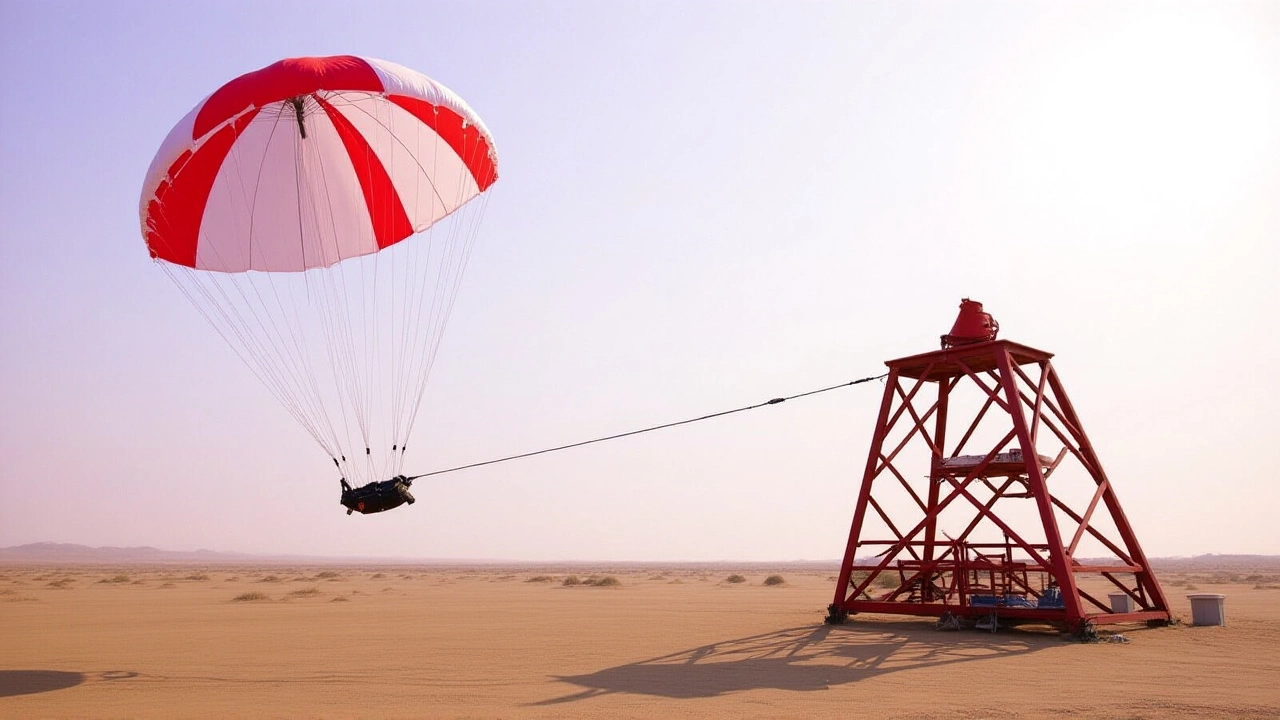
India’s ambitious journey to send humans into space just got a whole lot safer. The Defence Research and Development Organisation (DRDO) successfully completed a critical qualification-level load test for the drogue parachute system designed for the Gaganyaan mission. This isn’t just another routine check; it’s a vital stress test ensuring that when astronauts return from orbit, their ride back through Earth’s atmosphere won’t end in disaster.
The high-speed dynamic testing took place at the Rail Track Rocket Sled facility in Chandigarh, India. Here’s the thing: getting a parachute to deploy correctly at supersonic speeds while stabilizing a heavy crew module is incredibly difficult. One small failure, and the entire re-entry sequence could go wrong. That’s why this test matters so much.
The Critical Role of the Drogue Parachute
Think of the drogue parachute as the first line of defense during re-entry. When the crew module hits Earth’s atmosphere, it’s moving fast and potentially tumbling. The drogue chute deploys first—not to slow the craft down completely, but to stabilize it. It acts like a tether, straightening out the module so the main parachutes can deploy safely later.
Without this stabilization, the main chutes might tangle or fail to open properly. During the recent test, engineers monitored load, pressure, temperature, and acceleration data continuously. Every sensor reading was analyzed to prove the system meets design requirements under extreme conditions. As one report noted, this component is a "very important part" of astronaut safety, which is why it undergoes such rigorous scrutiny.
A Multi-Agency Collaboration
This wasn’t a solo effort by the DRDO. The test involved specialized teams from three major Indian institutions working in tandem. Alongside the DRDO’s Terminal Ballistics Research Laboratory (TBRL), experts from the Indian Space Research Organisation’s Vikram Sarabhai Space Centre (VSSC) and the Aerial Delivery Research and Development Establishment (ADRDE) contributed their expertise.
VSSC leads the development of launch vehicles and crew modules for Gaganyaan, while ADRDE specializes in aerial delivery systems. TBRL provided the advanced testing infrastructure. This collaboration highlights how India’s space and defense sectors are integrating capabilities to achieve complex national goals. The Ministry of Defence confirmed that this joint effort strengthens the overall readiness of the human spaceflight program.
Context: Recent Tests and Future Timeline
This load test follows other significant milestones. On August 24, 2025, ISRO conducted its first Integrated Air Drop Test (IADT-01) at the Satish Dhawan Space Centre in Sriharikota. That test validated the full parachute-based deceleration system in a realistic mission scenario. Now, with the drogue parachute’s structural integrity proven on the ground, confidence in the landing system grows.
Looking ahead, the uncrewed test flight, known as Gaganyaan-1, is scheduled for December 2025. This mission will carry an anthropomorphic robot named Vyommitra to Low Earth Orbit (LEO). Its purpose? To verify life support, avionics, and environmental control systems without risking human lives. If successful, it paves the way for crewed missions later in the decade.
Budget and Long-Term Vision
The scale of India’s space ambitions is reflected in its budget. The Gaganyaan program has been allocated ₹20,193 crore (approximately $2.32 billion). This funding supports an extended architecture including six uncrewed and two crewed flights by 2028. But the vision goes further.
By 2035, India aims to have an operational Indian Space Station. By 2040, there are plans for a crewed lunar mission. These aren’t just distant dreams; they’re part of a phased roadmap backed by substantial investment. Each test, like this parachute validation, is a brick in that foundation. Experts describe this achievement as a "significant milestone" for India’s human spaceflight aspirations.
Frequently Asked Questions
What exactly does the drogue parachute do?
The drogue parachute deploys immediately after the crew module enters Earth’s atmosphere. Its primary job is not to stop the descent, but to stabilize the module’s orientation. By reducing tumbling and slowing the initial speed slightly, it ensures the environment is safe for the main parachutes to deploy correctly later in the landing sequence.
Why was the test conducted in Chandigarh?
Chandigarh hosts the Terminal Ballistics Research Laboratory’s Rail Track Rocket Sled facility. This unique infrastructure allows for high-speed dynamic testing on the ground. Instead of launching into space every time, engineers can simulate the intense forces and speeds of atmospheric re-entry using rocket sleds, making the testing process faster and more cost-effective.
When is the first crewed mission planned?
While the exact date for the first crewed flight depends on the success of prior tests, the current roadmap targets two crewed flights by 2028. Before that, an uncrewed test flight (Gaganyaan-1) is scheduled for December 2025 to validate all critical systems, including life support and navigation, with a robotic dummy.
How much is India investing in the Gaganyaan program?
The approved budget for the Gaganyaan program is ₹20,193 crore, which translates to approximately $2.32 billion. This funding covers vehicle development, testing facilities, crew training, and future expansions like the proposed Indian Space Station by 2035 and a crewed Moon mission by 2040.